
Off to the Workhouse
The Poor are Always With Us
with Richard Churchley
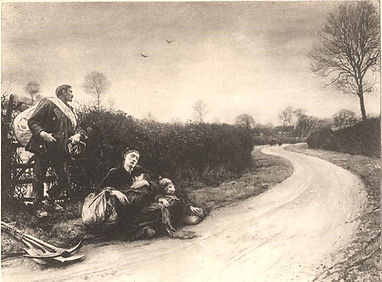
Members of the Vale of Evesham Historical Society were treated to a fascinating talk, when Dr Richard Churchley spoke to us about a history of relief of the poor.
Since the Second World War, said Richard, the provision of benefits to the needy had been taken over by national government. Before the war, however, the poor had been dealt with at a local level. Evesham hospital is built on the site of the Union Workhouse; indeed the workhouse chapel is now a pharmacy. (Over the course of the talk, it transpired that many local hospitals are either built on the sites of the workhouses or began as conversions of the workhouse buildings.)
Before the 1830s each parish was responsible for the care of its own destitute and had its own workhouse; that decade, however, saw the formation of the so-called Union Workhouses (accommodating the poor of a number of parishes combined). The workhouse for the Evesham area served villages in the Vale and also a number of parishes in Gloucestershire. It opened in April 1836 and catered for 200 inmates. An infirmary was added in 1870.There were two sorts of poor who needed help: those unable to maintain themselves – the young, the very old, the sick and disabled; and the able-bodied poor unable to find work.
Also, by the 1830s, many paupers were being relieved at home. At this period the poor rate was fourpence halfpenny in the pound on land, and threepence in the pound on houses. An allowance of eight shillings and sixpence per week was given to a labourer with 6 children. The average wage of an agricultural labourer in Worcestershire was one and fourpence a day. (In the Black Country, where alternative employment was available, wages would have been higher; the counties with the lowest rates of pay were the purely agricultural counties of Dorset and Norfolk.) For a poor man and his family, moving about the country wasn’t easy. Up to the nineteenth century there was what is known as a “place of legal settlement”. If someone died in the workhouse, for example, their body had to be taken back to their own parish for burial.
Richard also dealt with how the poor were assisted during medieval times, when acts of charity were believed to help peoples’ souls. As well as assistance from wealthy individuals, the poor could expect to be helped with alms from the monasteries and abbeys of the nation. After the Dissolution, of course, the latter source of assistance disappeared. From Henry VIII’s time we see the appearance of the Poor Laws (the earliest being dated 1531).
We first hear mention of workhouse (or poorhouses) in 1723. In individual parishes, church wardens and overseers could hire a house for the maintenance and setting to work of the poor. Richard illustrated his talk with a striking example from his own family history. At the end of the 17th century, one Francis Churchley appears from tax records to be the fifth richest person in Alcester (judging by the amount of tax levied). In 1711, however, he died in an epidemic, leaving a wife and eight children to go on the parish. Benjamin, his youngest child, born posthumously, remained at home with his mother - who received payments until 1721, when he was old enough to be apprenticed to James Farr, a tailor in his own village. Benjamin became a successful tailor himself, and was even able to style himself “gentleman”.
This was a very interesting talk from someone who really knew his subject. It provoked a lot of discussion amongst the listeners.